
What an Apostille Actually Does
An apostille authenticates the origin of certain public documents for use abroad when the 1961 Hague Apostille Convention applies. It confirms the authenticity of a signature, the signer’s capacity, and the seal or stamp on the document. It does not confirm that the document’s statements are true. An apostille is therefore an authentication step, not approval of the document’s content.
The Document Journey From Issuer to Foreign Authority
A practical way to understand apostilles is to follow one document from its issuer to the authority abroad that will receive it. For documents that also need translation, rapidtranslate.org provides certified apostille translation and can translate the apostille with the underlying document. Translation and apostille remain separate functions. The order below is a common model, but local rules can change it.
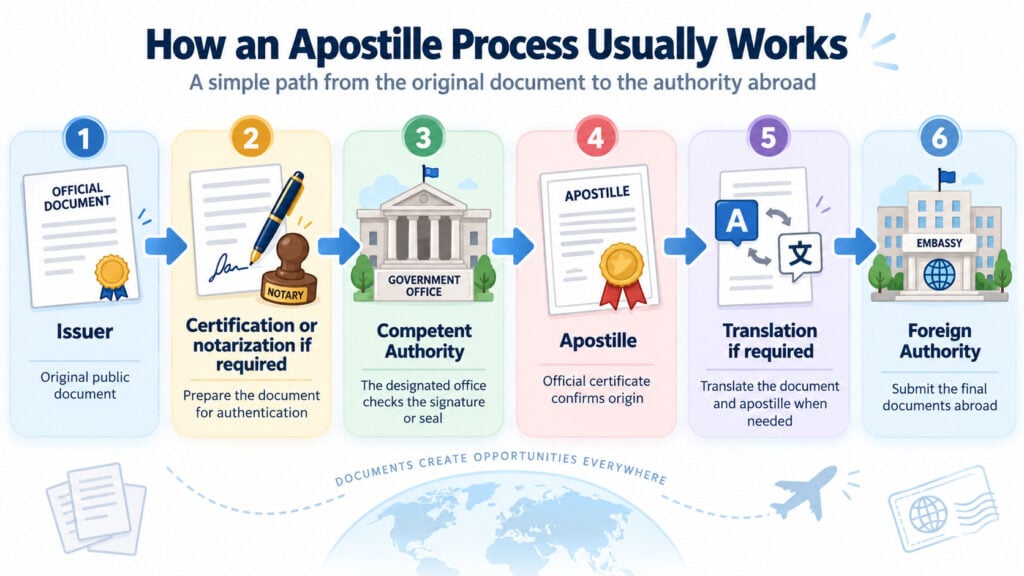
Step 1: Start With the Correct Document
The process begins with an original or an acceptable certified copy from the issuing authority. Birth certificates, court records, diplomas, and other records can have different preparation rules. Some need an intermediate certification before an apostille can be issued. Starting with the wrong copy can stop the process early.
Why Certification May Come Before the Apostille
Certification is not another word for apostille. Depending on the document and place of origin, a signature may first need notarization or another official certification so the competent authority can verify it. Official guidance for both U.S. and UK documents shows that preparation can include certification or notarization before the document reaches the final authentication stage.
Step 2: The Competent Authority Issues the Apostille
Only a competent authority designated under the Convention can issue an apostille. That authority verifies the origin of the public document and issues the certificate. It does not decide whether the document’s contents are accurate.
For U.S. documents, the correct authority depends on the source of the record. Federal documents may be handled by the U.S. Department of State, while state documents are generally authenticated through the issuing state. The destination matters because documents outside the applicable Convention route use different authentication procedures.
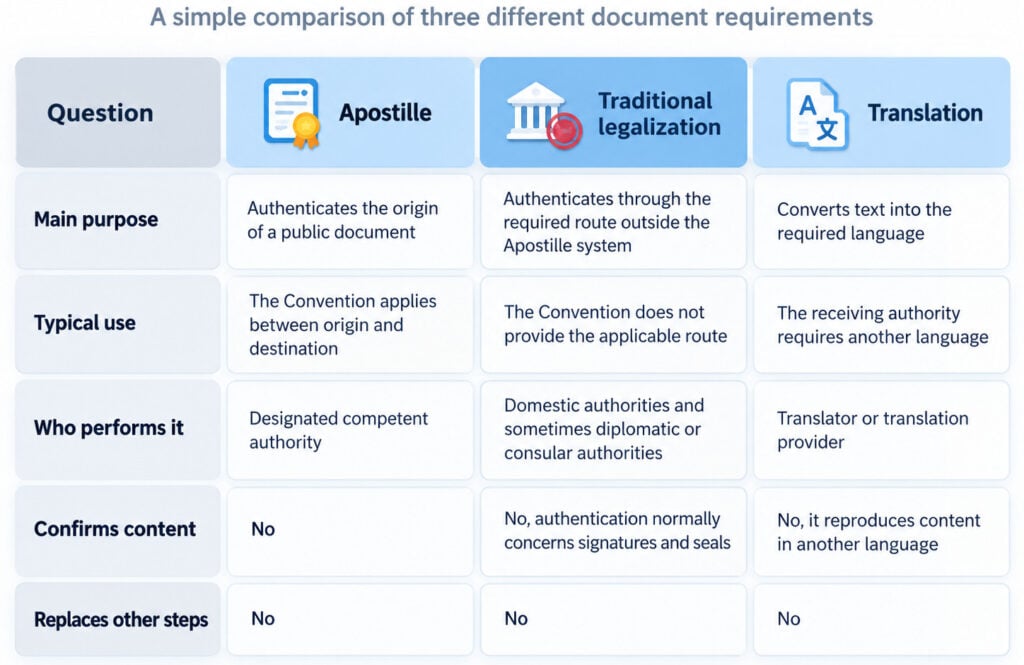
Apostille vs Legalization vs Translation
Apostille, legalization, and translation solve different problems. An apostille authenticates document origin, traditional legalization handles authentication where the Convention does not replace the older process, and translation makes the text usable in another language. Terminology differs between authorities. Some governments use “legalization” broadly and may describe attaching an apostille as legalizing a document.The distinctions in the table follow the HCCH explanation of the Apostille Convention and current government guidance on authentication and legalization outside the Convention process.
Step 3: Translation Can Come Before or After Apostille
One practical sequence is to complete translation after the apostille so the final translation can cover both the document and the apostille certificate. That sequence is not universal. The receiving authority may require a different order.
Current U.S. Department of State guidance gives a useful example. For certain federal documents, when the destination requires translation from English, applicants are instructed to obtain a professional translation and notarize the translated copy before submitting the authentication request. The sequence should therefore be checked rather than assumed.
The apostille itself may also need translation. Rapid Translate states that apostille translation can cover both the official document and the attached apostille when required. The final language requirement still comes from the authority receiving the document.
When an Apostille Is Not the Right Route
An apostille is not required simply because a document crosses a border. The Convention applies to qualifying public documents when its rules operate between the places involved. The receiving authority still determines what must be submitted for the transaction.
For destinations outside the applicable Convention route, other authentication steps may be required. The U.S. Department of State uses authentication certificates for documents going to countries outside the 1961 Hague Convention framework. Some destinations can also require embassy or consular authentication.
An apostille does not make a document automatically acceptable for every legal purpose abroad. HCCH guidance states that an apostille authenticates origin rather than the content of the underlying record. Acceptance and legal use still depend on the destination’s requirements.
A useful pre filing check covers five points. Confirm the issuing country, destination country, document type, competent authority, and receiving authority’s translation instructions. This shows which authentication and translation steps are actually needed before time or money is spent on the wrong sequence.
The final lesson is that an apostille is one link in a document chain, not universal international approval. Legalization handles a different authentication route, while translation addresses language. The most reliable process starts with the foreign authority’s requirements and works backward to the issuer. Each step then has a defined purpose.


Marissa is a Pediatric Occupational Therapist turned stay-at-home mom who loves sharing her tips, tricks, and ideas for navigating motherhood. Her days are filled starting tickle wars and dance parties with three energetic toddlers and wondering how long she can leave the house a mess until her husband notices. When she doesn’t have her hands full of children, she enjoys a glass (or 3) of wine, reality tv, and country music. In addition to blogging about all things motherhood, she sells printables on Etsy and has another website, teachinglittles.com, for kid’s activity ideas.


