
Do You Really Need a Portable Baby Bottle Warmer When Going Out?
Do you really need a portable baby bottle warmer when going out? Not always. If your baby accepts cold or room temperature milk, a simpler setup may be all you need. But if warm milk is non-negotiable, a portable warmer is worth packing, especially on road trips, daycare runs, or any outing where the next coffee shop is not around the corner.
This guide walks through what parents actually do to warm bottles on the go, where those methods tend to break down, and what to look for if you decide a portable warmer is worth adding to your bag.
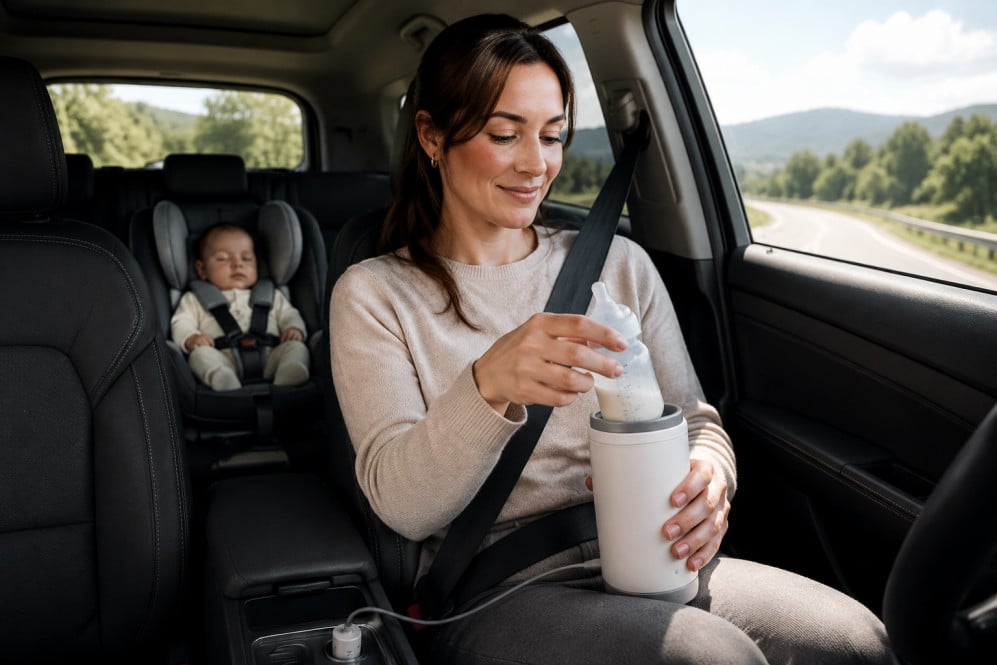
Parent warming baby bottle using portable device in car during road trip with baby in back seat.
Why Feeding Timing Is the Real Problem
The outing itself is usually not the hardest part. You can pack diapers, wipes, a change of clothes, snacks, a stroller fan, and the extra burp cloth you know you will need. The hard part arrives later, often in a parking lot or at the corner table of a cafe, when your baby is crying and the bottle is still cold.
That moment feels bigger than it looks from the outside. You are checking the diaper bag, asking whether the water is still warm, trying not to spill anything, and wondering how many minutes your baby can wait before the whole room turns toward you.
The problem is feeding timing. Babies do not always get hungry at the convenient part of the errand. A nap runs short. Traffic adds twenty minutes. A bottle that seemed “almost ready” at home is not ready anymore. For some babies, that is fine. For others, cold milk is an immediate no.
The CDC notes that breast milk does not have to be warmed and can be served cold or at room temperature, but it also gives safe warming steps if you choose to warm it. That difference matters. “Safe to serve cold” and “your baby will accept it cold” are not the same thing.
How Parents Warm Bottles on the Go
Most families start with the “make it work” options before they buy anything. They do work — until they collide with real life: winter air, a screaming baby, nowhere to set a bottle down, and one hand that is always busy.
Thermos Warm Water Method
The thermos method is probably the most common workaround. You fill an insulated bottle with hot water before leaving, bring a cup or container, and place the baby bottle in the warm water when it is time to feed.
The appeal is that it is simple and cheap, and it matches what major guidance recommends at home: warm milk in warm water, not a microwave.
Where it breaks down is temperature control and mess. The water can start out too hot, then swing the other way by the time you actually need it. In winter it cools faster than you expect, and in a car or stroller you may not have a stable place to pour without splashing.
Finding Hot Water at a Cafe or Restaurant
Another common move is asking for hot water at a coffee shop, restaurant, hotel breakfast area, or airport lounge. A place like Starbucks may help in a pinch, and many parents have done exactly that.
This is surprisingly workable when you are in town and have a few minutes. The problem is that it is a plan built on “we will be near a counter.” If your feed hits at a park, on a long highway stretch, or at a campsite, there may be no hot water to ask for. Even when there is, you still have the water-bath juggling act: wait, test, cool down if you overshot, then pack up wet gear.
The other issue is timing. If your baby is already upset, “let me find someone who can give me hot water” may be technically possible but emotionally exhausting.
Making Formula on the Go
For formula-feeding families, the challenge is slightly different. Rather than warming a stored bottle, the goal is mixing formula at the right temperature from scratch — usually by combining hot and cool water in the right ratio.
Some parents carry two thermoses for exactly this reason. As one parent put it: “I put a set amount of hot water and formula to sterilise it and mix. Then I top up with cold water.” It can work, but the only variable — water temperature — is also the hardest to control away from home.(Source: Reddit)
If you use a “hot then cool” routine, it helps to treat it like a recipe: measure, keep your steps consistent, and do not improvise with a microwave. AAP notes you can warm a prepared bottle with warm running water or a container of warm water, and it warns against microwaving formula because it can create hot spots that burn a baby’s mouth.
Cold Milk or Room Temperature Feeding
Some babies take cold breast milk or room temperature formula without a second thought. If that is your baby, you have a real advantage. You can store milk safely, feed when needed, and skip warming altogether.
Other babies reject the bottle unless the milk is warm. This is not a parenting failure or a sign that you did something wrong. Babies have preferences, and those preferences can change by age, feeding history, bottle type, and mood.
Every baby is different. That is why the best answer depends less on the product category and more on your baby’s actual feeding pattern.
What to Look for in a Travel Bottle Warmer
If you decide a warmer makes sense, do not shop only by the word “portable.” A good travel option should solve the actual problem: feeding your baby at the moment they need it, without creating a new cleaning or charging problem.
Here are the four checks that matter most when you are actually out of the house.
| What to Check | Why It Matters When You Are Out |
|---|---|
| Ready when needed | A warmer that works while plugged in or in the car is more dependable on long days. |
| Easy to carry | If it is too bulky, it stays home. Cup-holder fit and diaper-bag fit matter. |
| Fast warming | Around 3 to 5 minutes is realistic for a crying-baby moment. |
| Easy cleaning | Milk touches the warmer, so wide openings and washable parts save time. |
For breast milk, temperature handling deserves extra care. The CDC advises warming sealed milk in warm water or under warm running water, testing drops on your wrist, and avoiding microwaves because hot spots can burn a baby’s mouth and high heat can affect milk quality.The AAP gives similar advice for expressed breast milk and formula.
Cleanliness matters too. The CDC notes that germs can grow quickly in breast milk or breast milk residue left on feeding equipment, which is why careful cleaning and sanitizing guidance exists for pump parts and infant feeding items.
This is the real bottle warmer vs warm water tradeoff. Warm water can be perfectly safe and useful, but it is only as reliable as your access to it and your ability to control the temperature. A portable warmer is not “better” by default — it is better only if it makes your routine more consistent and less rushed.
A Simpler Way to Handle Feeding on the Go
The simplest travel feeding setup is the one with the fewest moving parts. You do not want to hunt for hot water, pour it into a container, wait, retest, cool the bottle, and then repack wet items while your baby is still upset.
If warming is the part that keeps falling apart for you, a portable bottle warmer can remove the biggest bottleneck: getting warm milk at the exact moment your baby wants it, without the “where can I find hot water?” detour.
For parents who want that kind of routine, the eufy Portable Milk Warmer E10 is built around on-the-go feeding rather than kitchen-counter warming. It heats 4 oz of milk in about 3.5 minutes and water in about 2 minutes. It can also heat while plugged in, even at 0% battery, which matters on road trips or long days when you forgot to charge one more thing.
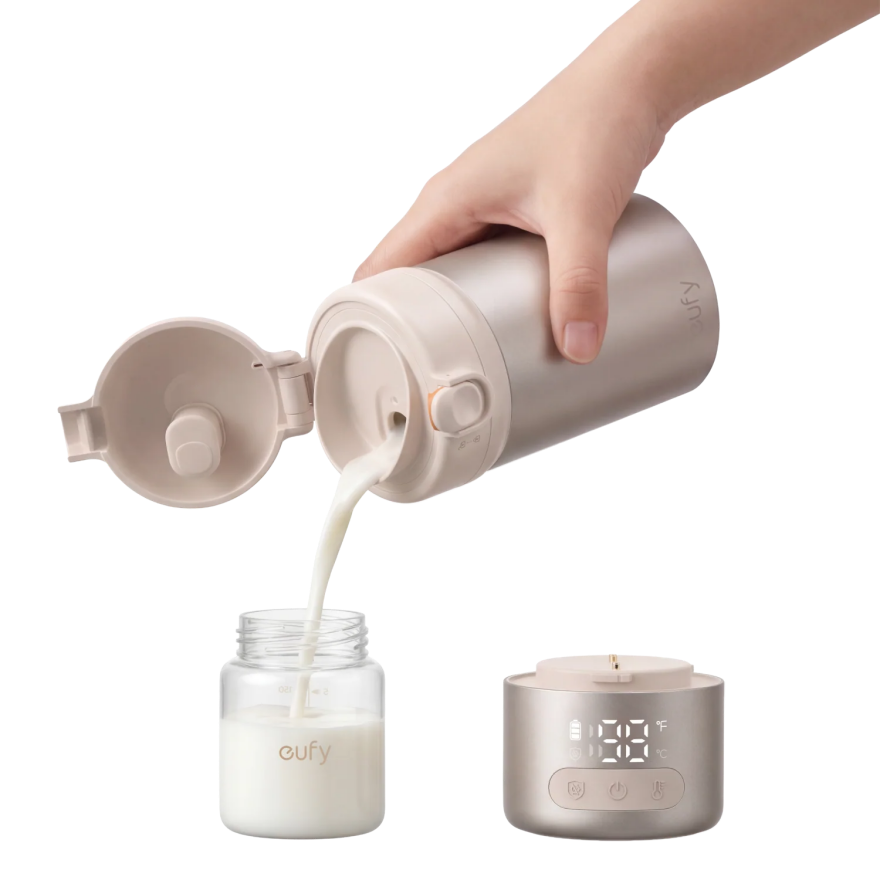
eufy Portable Milk Warmer E10
The design is practical in the small ways parents notice. The detachable base reduces carry weight, the wide mouth makes pouring and cleaning easier, and the fully washable cup design helps prevent milk residue from becoming tomorrow’s problem.
Do You Actually Need One?
You do not need one just because you leave the house. You need one when your current method keeps failing at the worst moment: your baby is hungry now, and the bottle is not ready.
It tends to be worth it if:
- Your baby refuses cold bottles and only settles for warm milk.
- You regularly feed away from home (daycare runs, long errands, road trips, weekends with family).
- You are often in places where hot water is not easy to get (car, park, outdoors).
On the other hand, you can probably skip it if:
- Your baby takes cold or room temperature milk.
- Most outings are short, and feeds usually happen before you go or after you get home.
If you are in the middle, use a simpler test: think about your last three outings. Did warming milk feel easy, or did it steal attention at exactly the moment you needed both hands and a calm brain? A warmer is not a moral upgrade, and warm milk is not automatically “better” for every baby — it is a convenience tool that earns its spot when it removes repeated friction.
Conclusion
Feeding a baby outside the house is already complicated enough. If warming is the part that keeps breaking down, a portable warmer earns its spot in the bag. If it is not, you probably do not need one.


Marissa is a Pediatric Occupational Therapist turned stay-at-home mom who loves sharing her tips, tricks, and ideas for navigating motherhood. Her days are filled starting tickle wars and dance parties with three energetic toddlers and wondering how long she can leave the house a mess until her husband notices. When she doesn’t have her hands full of children, she enjoys a glass (or 3) of wine, reality tv, and country music. In addition to blogging about all things motherhood, she sells printables on Etsy and has another website, teachinglittles.com, for kid’s activity ideas.


